The Creative Support Circle
A grounded visual framework for supporting gifted, sensitive, and neurodiverse children. Discover how emotional safety, play, and whole-child understanding work together in a continuous cycle.
The Creative Support Circle
A grounded visual for gifted, sensitive, and neurodiverse children.
Think of this as a circle with three connected arcs, not a hierarchy.
No starting point. No "right" order.
You enter wherever the child is.
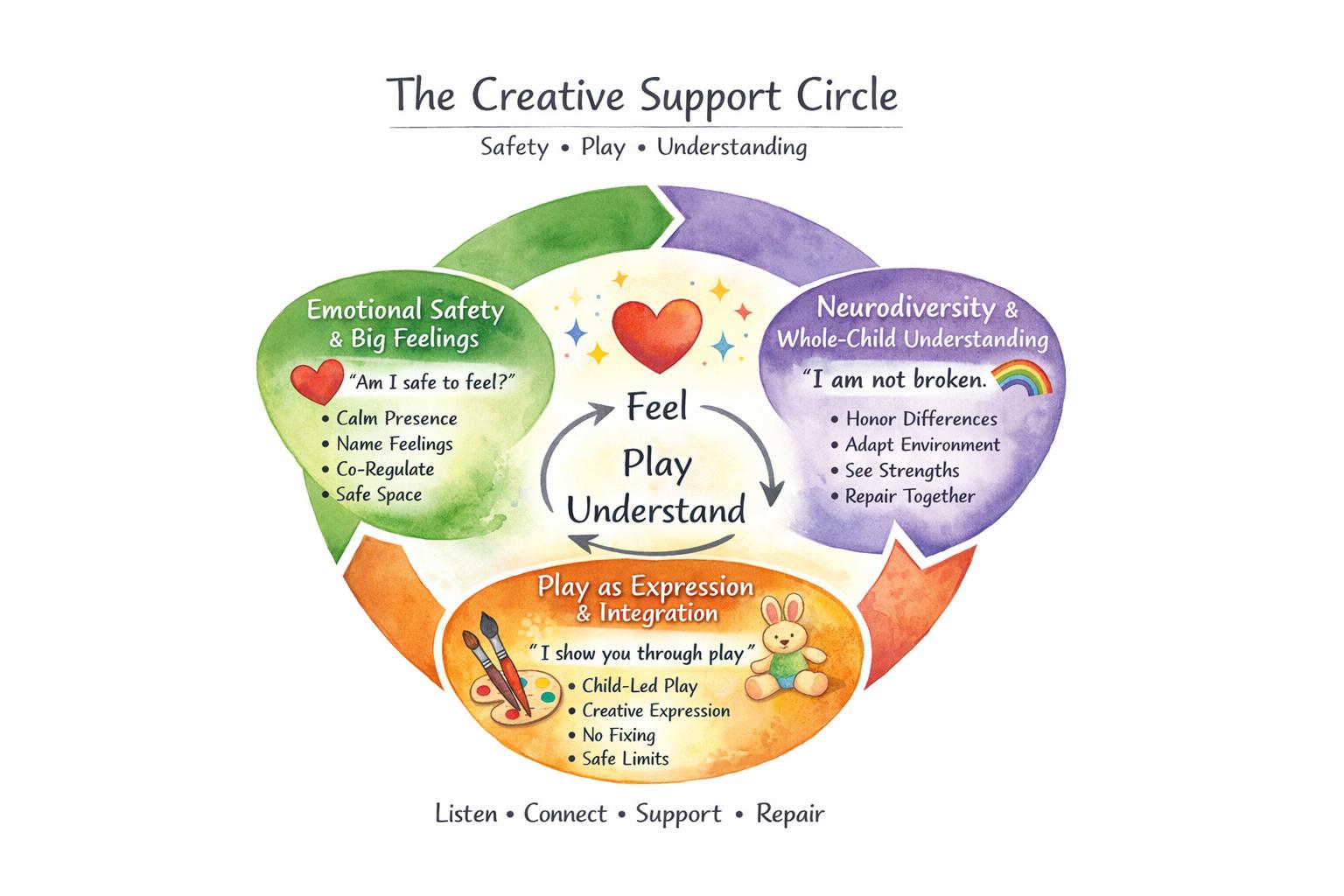
ARC ONE: Emotional Safety & Big Feelings
"Am I safe to feel?"
This arc holds:
- Big emotions
- Meltdowns
- Anxiety
- Overwhelm
Adult posture:
Presence before problem-solving
Key supports:
- Naming feelings gently
- Co-regulation
- Calm spaces
- Emotional mirroring
When this arc is unmet:
Children escalate or shut down.
When it is met:
The nervous system softens enough for expression.
ARC TWO: Play as Expression & Integration
"I show you through play."
This arc holds:
- Symbolic play
- Repetition
- Control themes
- Imagination
Adult posture:
Follower, witness, emotional anchor
Key supports:
- Child-led play
- Open-ended materials
- No fixing, teaching, or interpreting
- Safe limits, free expression
When this arc is unmet:
Feelings stay trapped or come out as behavior.
When it is met:
Emotions move, stories resolve, tension releases.
ARC THREE: Neurodiversity & Whole-Child Understanding
"I am not broken."
This arc holds:
- Brain differences
- Sensory needs
- Strengths and challenges together
- Identity formation
Adult posture:
Curiosity instead of correction
Key supports:
- Environmental adjustments
- Strength recognition
- Collaborative problem-solving
- Repair after rupture
When this arc is unmet:
Children internalize shame or resistance.
When it is met:
Self-trust and resilience grow.
Back to Emotional Balance
Because regulation is cyclical, not linear.
The Circle in One Simple Line (for parents)
Feel → Play → Understand → Feel safer → Play more freely → Be understood
How Families Can Use the Circle Practically
When something is hard, ask one question, not all three:
Emotional Safety:
Does my child feel safe right now?
Play:
Can this be expressed through play instead of words?
Understanding:
What might this behavior be telling me about their needs?
You don't need to fix the whole circle.
Touching one arc gently supports the others.